My sister’s daughter received nineteen presents her first December. By the following March, seventeen of them lived in a bin in the garage, still in their packaging. Not because anyone was careless. Because a four-month-old cannot open a box, cannot hold a rattle for longer than nine seconds, and has no opinion about a monogram.
That’s the awkward truth about a baby’s first Christmas: the honoree is not really the audience. The baby gets one good photograph out of the whole thing and then falls asleep. Which means the gift has two real judges, and neither of them is wearing a onesie. One is the parent awake at 3 a.m. in February. The other is the adult who opens a keepsake box in 2045. Eighteen ideas below, sorted by which of those two you’re shopping for.
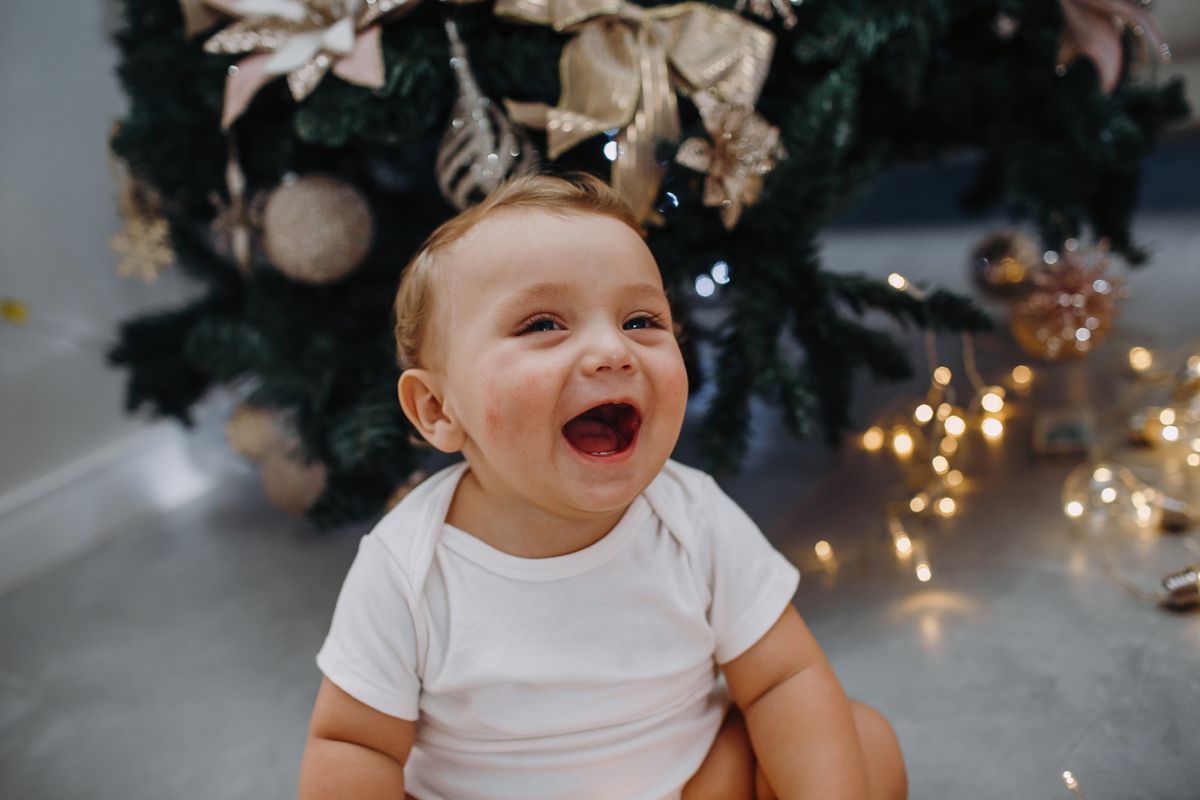
How to judge a first-Christmas gift
Run every candidate through two questions before you pay for it.
First: does it get used before the tree comes down? A first Christmas falls in the middle of the hardest stretch of a baby’s first year — the night feeds, the cold season, the part where nobody in the house has slept properly since September. Anything that makes one of those hours easier is worth three of anything that doesn’t.
Second: will it still mean something in twenty years? Very few things pass that test, and that’s fine. Buy one or two keepers and spend the rest of your budget on things that get destroyed by use.
Two safety notes, since this is the age where it matters most. Skip anything with a button battery, which includes a surprising number of musical books and light-up toys. And ignore the age printed on the box; a gift marked six months plus is a gift for a baby who will be six months old in March, not December.
For the baby, who won’t remember any of it
Ten things that get used hard between Christmas and spring. Most of them are boring on purpose. Boring is what a baby actually needs at this age.
1. A merino sleep sack— Best for the baby who runs cold at 3 a.m.
The 3 a.m. wake-up where a baby is cold but not cold enough for another layer is the most common problem of a first winter. Merino holds temperature without the quilted bulk, and a two-way zip means you are not undoing fifteen snaps while somebody screams. Buy the size they will be in February, not the size on the label.
2. A three-pack of muslin swaddles— Best for everything except swaddling
You will use these for burp cloths, a sunshade over the stroller, an emergency changing surface, and a barrier between a cheek and a public bench. Three matters because one is always in the wash, one lives in the diaper bag, and one has vanished into the car.
3. A second organic crib sheet— Best for the 3 a.m. sheet change after a blowout
Changing a crib sheet at that hour is a two-person job at the best of times. A spare means you strip, swap, and go back to bed instead of starting laundry at dawn. Get deep pockets; thin corners pop off around 4 a.m., and that is how a baby ends up asleep on a bare mattress pad.
4. A tummy time water mat— Best for buying four extra minutes of tummy time
Tummy time is the part of the day everyone dreads, including the baby. Fill the mat and the floating shapes give them something to push up and stare at, which buys you a few minutes before the protest starts. It folds flat, so it lives behind the couch and comes out twice a day.
5. High-contrast pattern cards— Best for the six-week-old who can't see pastel yet
Newborn eyes can't separate pale pink from pale yellow. Black-and-white patterns are the one thing a very young baby will track across a room, and the cards double as a distractor during diaper changes. Keep two in the diaper bag. They weigh nothing and they work in a waiting room.
6. A set of soft sensory balls— Best for the beginning of grabbing
Around six months, hands start working and everything goes in the mouth. These are light enough that a failed throw doesn't hurt, textured enough to be interesting to gums, and quiet. Quiet matters more than any product listing will ever tell you.
7. Solid silicone teethers— Best for the freezer, not the toy box
Teething arrives earlier than the books promise. I would skip the gel-filled ones, because a determined chewer can find the seam. Solid silicone with a little rattle inside is the version worth buying: cold, chewable, and unbothered by the dishwasher.
8. A suction plate and bowl set— Best for meals that stay on the tray
The suction base is the entire point. Around eight months a baby discovers they can lift the plate, and after that mealtime is a physics experiment. A plate that stays put means you clean one surface instead of a floor, a chair, and a wall.
9. A bamboo hooded towel set— Best for bath time without the screaming
Baby towels are absurdly small and get outgrown by month four. Bamboo ones are bigger, dry faster than terry, and stay soft after forty washes, which is roughly how many baths you will run before spring. The hood actually covers the head, so the post-bath protest is shorter.
10. A boxed board book library— Best for starting the habit before there's a habit
At this age a book is a chew toy with pictures, and that is exactly right. Board pages survive being sat on, thrown, and wiped. You will read the same three over and over; the repetition is the mechanism, not a failure of imagination.
For the parents, who will remember all of it
This is the section that gets skipped, and it shouldn’t be. A six-month-old wants the box. The people who will actually be awake at 3 a.m. are the ones who need something.
11. A rechargeable portable bottle warmer— Best for the overnight feed
The worst fifteen minutes of a new parent's day involve a cold kitchen, a screaming baby, and one hand on a kettle. A rechargeable warmer gets a bottle to temperature in the nursery, so nobody has to walk downstairs and wake up properly. This is the gift that gets thanked in person, out loud, in front of other people.
12. A diaper caddy with a wipeable lining— Best for keeping the 2 a.m. change on the bed
Not glamorous. Also the reason a night change doesn't turn into a search party. One caddy holding diapers, wipes, a pad, and a spare onesie means the whole operation stays in one place. Get the wipeable lining; the fabric ones look lovely for about three weeks.
13. An electric nasal aspirator— Best for the first cold, which is coming
Every parent I know resisted buying one and then wished they had owned it in November. A baby with a blocked nose can't sleep, can't feed, and can't blow, so the whole house is up. Electric models are easier to work one-handed than a bulb syringe, and one-handed is the only mode available at 2 a.m.
14. A portable changing pad clutch— Best for the first outing with a newborn
Leaving the house with a baby is a logistical event. A clutch that unfolds into a changing surface, with pockets for wipes and a diaper, lets you change a baby on a restaurant bathroom floor without touching it. It also fits inside a tote, so it outlives the diaper bag.
For the box they open in 2045
Four things worth keeping. Buy one, not all four, unless you are the grandparent and have decided to ignore that advice.
15. A clay hand and footprint kit— Best for the hands that change fastest
You will mean to do this at three weeks and get around to it at five months, and the footprint will be from a much bigger baby. Air-dry kits are simple enough for a Tuesday night, and the result is the thing grandparents cry over at Christmas dinner.
16. A first-year memory book with short prompts— Best for parents who will actually finish it
Most baby books die around month five, usually because the prompts demand an essay. The ones that survive ask for a line or two and leave space for a photo you can stick in rather than a print you have to order. Look for a page per month, and no requirement to be poetic.
17. A knit milestone blanket— Best for the monthly photo everyone takes
The numbered-marker photo is the one baby tradition that survived social media, and for good reason: it takes ten seconds and produces a record with no effort. A knit one doubles as a lap blanket, so it isn't a prop that lives in a drawer for eleven months.
18. A personalized wooden name puzzle— Best for still being used at three
This is the rare first-Christmas gift with a second life. By two, the letters come out and go back in; by three, the name gets spelled out loud at the table. Order early, though. Custom engraving crawls through the postal system in December, and a January arrival is a much sadder present.
What I would skip
Anything with the words first Christmas printed on it in glitter, because it is a decoration, not a gift, and it will be in a bin by January 2. Stuffed animals, of which the baby will receive eleven regardless of what you do. And any toy that plays a song at volume, unless you have confirmed that the parents enjoy hearing that song four hundred times, which they will not.
The short version
If you only have one gift to buy, buy for the parent. The baby gets a photograph either way, and the photograph doesn’t care what was in the box. A warmer, a caddy, a spare sheet — one of those will be thanked out loud in March by someone who has not slept properly since September, and that is a better return than a monogrammed rattle.
Our editor’s pick is the portable bottle warmer, for the simple reason that it is the only item on this list that changes a specific, recurring, miserable hour of somebody’s day. Everything else is a nice thing to own. That one is a small mercy at 3 a.m., and small mercies are what a first Christmas is actually made of.
FAQ
What do you buy for a baby’s first Christmas? Buy for the routine the family already has. A sleep sack, a spare crib sheet, a suction plate, or a bottle warmer will be used within days. Add one keepsake if you want something to survive the year. Skip decorative items and anything the baby cannot touch.
Is it rude to give clothes for a baby’s first Christmas? Not if the clothes are sized for the season ahead and easy to put on. Zips beat snaps, and nothing with a collar. Avoid outfits that only work for a photograph; parents are drowning in those already, and a plain everyday sleeper in the right size is genuinely welcome.
How much should you spend on a baby’s first Christmas gift? Most people land between twenty-five and sixty dollars, which buys something genuinely useful at this age. Grandparents often spend more, and that money goes furthest on a piece of furniture or a merino sleep sack. There is no etiquette rule, only a usefulness test.